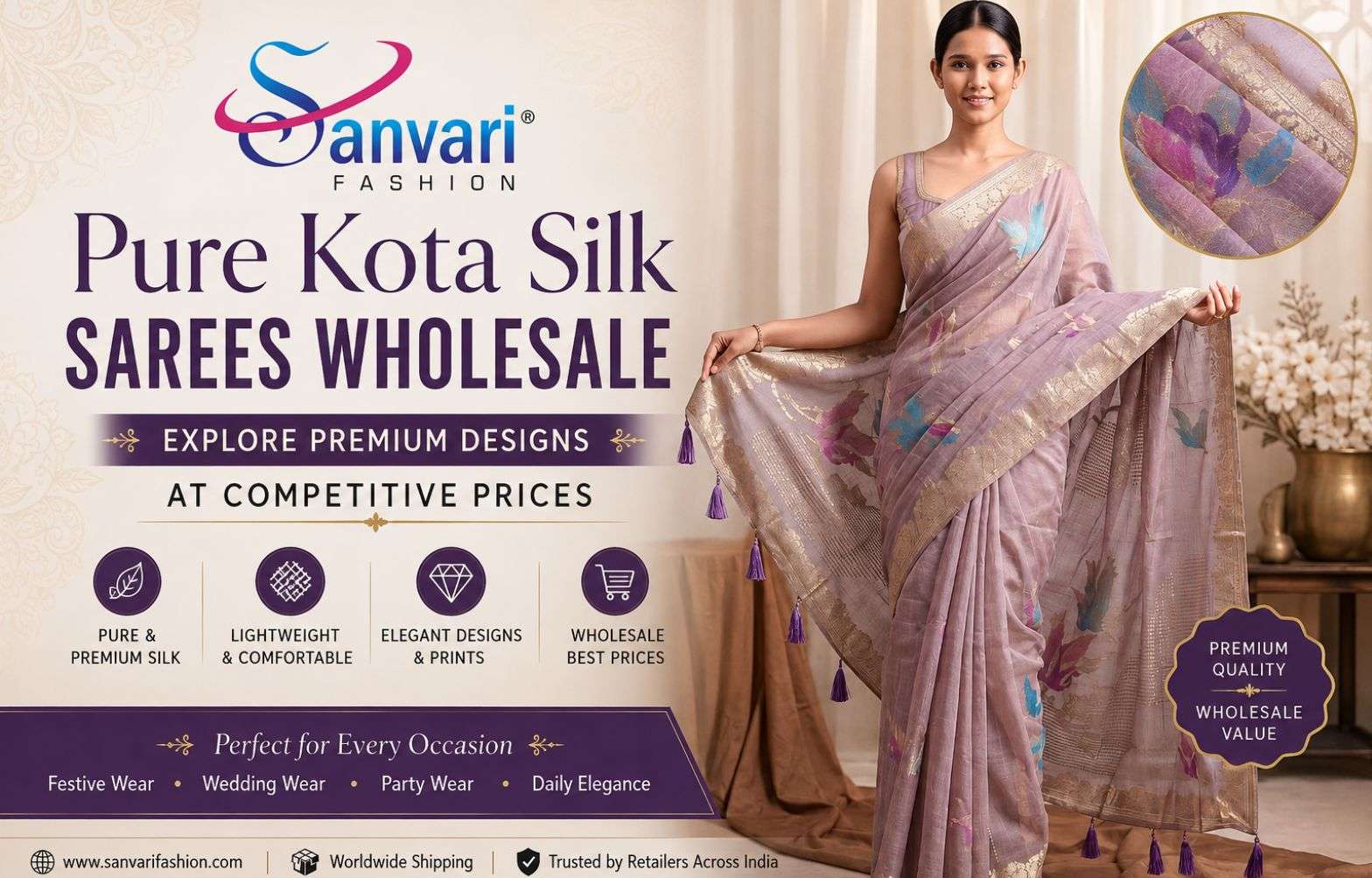
Kota silk sarees are known for their lightweight feel, elegant texture, graceful drape, and suitability for both festive and everyday occasions. For retailers, boutique owners, resellers, and online fashion businesses, pure kota silk sarees wholesale can be a practical way to build a premium saree collection while maintaining competitive selling prices. Choosing the right fabric, weave, colours, prints, borders, and supplier can make a major difference when purchasing sarees in bulk.
Quick Questions: Where can retailers source pure Kota silk sarees in bulk? What should buyers check before selecting a wholesale saree collection? Are pure silk sarees suitable for festive and wedding customers? How can retailers balance premium sarees with affordable inventory? The answers depend on fabric quality, catalogue variety, wholesale terms, customer demand, and supplier reliability.
The popularity of pure Kota silk sarees wholesale comes from the combination of traditional styling and lightweight comfort. Kota-inspired weaving is associated with an airy texture and delicate appearance, making these sarees attractive to customers who want an elegant ethnic outfit without an overly heavy feel.
For retailers, sarees with versatile styling potential can appeal to several customer groups. Depending on the design, they can be promoted for festivals, family functions, daytime celebrations, office occasions, religious events, and casual ethnic dressing.
When purchasing in bulk, buyers should examine fabric composition, finishing, colour consistency, border quality, blouse-piece details, print or weaving work, and overall presentation. A beautiful catalogue becomes more valuable when its quality matches customer expectations.
Reliable pure silk saree wholesale suppliers can help retailers access different designs and price segments without sourcing every collection separately. Before placing a large order, buyers should compare catalogue variety, minimum order quantities, product descriptions, shipping policies, return conditions, and available customer support.
Wholesale sourcing is not simply about finding the lowest price. A supplier offering consistent quality and attractive designs can help a retailer develop repeat customers and reduce the risk of slow-moving stock.
Retailers should also consider whether a supplier offers online ordering and nationwide delivery. This can be particularly useful for businesses located outside major textile centres.
Retailers looking for a balance between silk-like elegance and everyday practicality may also consider pure silk cotton sarees wholesale collections. Silk-cotton blends can offer attractive textures and comfortable draping, depending on the construction and fabric composition.
These sarees can be positioned between basic daily-wear sarees and premium occasion-wear collections. For a shop owner, this creates an opportunity to serve customers with different budgets.
A well-planned saree inventory can include lightweight sarees, printed designs, traditional patterns, festive colours, contemporary combinations, and premium-looking borders. The goal is to provide customers with enough variety without unnecessarily tying up capital in slow-moving designs.
Pure soft silk sarees wholesale collections can be useful for retailers targeting customers who prefer richer textures and more traditional styling. Soft silk designs can work particularly well for weddings, festivals, receptions, family functions, and other special occasions.
Retailers should check the exact fabric description before marketing a saree as pure silk. Product terminology can vary between suppliers, so buyers should rely on the stated composition and product specifications rather than judging fabric solely from photographs.
A practical inventory strategy is to keep a combination of premium and mid-range sarees. This allows customers to compare options according to occasion and budget.
The design selection is one of the most important factors when building a wholesale saree catalogue. Customers may have different preferences based on age, location, occasion, and fashion trends.
Floral motifs, traditional patterns, geometric designs, zari-inspired borders, delicate prints, contrasting pallus, and contemporary colour combinations can all add variety to a collection.
Retailers should also consider seasonal demand. Bright colours and festive patterns can work well during celebrations, while softer shades and subtle prints may appeal to customers shopping for daytime or regular ethnic wear.
Block printed pure silk sarees wholesale collections can bring a handcrafted-inspired appearance to a retail assortment. Traditional block-style motifs, floral patterns, ethnic designs, and repeating prints can give sarees a distinctive visual identity.
For boutiques, printed silk sarees can be promoted as elegant choices for customers who want something different from heavily embroidered occasion wear. Retailers can combine printed designs with plain or minimally decorated sarees to create a balanced collection.
When buying printed sarees in bulk, check the sharpness of motifs, colour consistency, border finishing, fabric feel, and overall presentation across the catalogue.
The growth of online B2B fashion shopping has made pure silk sarees wholesale online sourcing more convenient for retailers. Instead of travelling to multiple markets, buyers can review catalogues, compare products, check available specifications, and shortlist designs remotely.
Online sourcing is especially helpful for boutique owners and resellers who need to refresh their inventory regularly. However, buyers should still verify wholesale terms, minimum quantities, shipping costs, applicable taxes, and return or replacement policies before confirming an order.
Retailers can also use online catalogues to identify complementary categories. For example, a store selling sarees can add dress materials to serve customers looking for customizable ethnic outfits. Sanvari Fashion's wholesale dress materials collection includes cotton, printed, embroidered, designer, and other dress-material options, giving retailers an opportunity to broaden their ethnic-wear assortment.
The demand associated with indian clothing stores in surat reflects the city's importance in India's textile and fashion supply chain. Surat has a large ecosystem of manufacturers, wholesalers, traders, catalogue suppliers, and retailers serving customers across India.
For buyers, sourcing from Surat can provide access to frequently updated collections and multiple price segments. Retailers can explore sarees alongside kurtis, dress materials, ready-made garments, and other women's fashion categories.
This makes Surat particularly relevant for businesses looking to build a diversified ethnic-wear inventory rather than relying on only one product category.
Before placing a wholesale order, retailers should create a simple purchasing checklist:
Understand your customer: Identify the colours, designs, fabrics, and price points your customers prefer.
Compare collections: Review multiple catalogues instead of choosing only from one design group.
Check fabric information: Confirm whether the saree is pure silk, silk blend, cotton-silk, or another composition.
Review MOQ: Make sure the minimum order quantity suits your inventory budget.
Calculate total cost: Include product price, GST where applicable, shipping, and other charges.
Evaluate variety: Select designs that cover different occasions and customer preferences.
Confirm supplier policies: Check shipping, replacement, return, and damaged-product procedures.
Start strategically: New retailers can begin with a manageable assortment and expand according to sales performance.
This approach helps transform wholesale purchasing from a price-focused decision into a long-term inventory strategy.
A successful saree collection does not necessarily require hundreds of designs. Instead, retailers can focus on a carefully selected mix of products.
A premium section can include silk and soft-silk styles, while lightweight Kota-inspired sarees can target customers looking for comfort and elegance. Printed sarees can provide an attractive middle segment, while affordable everyday designs can bring regular footfall.
Retailers can also create occasion-based merchandising. For example, wedding collections can focus on richer colours and premium borders, while summer collections can highlight lightweight fabrics and breathable designs.
For businesses expanding beyond sarees, Sanvari Fashion also provides a broad range of women's fashion categories. Its website describes collections spanning traditional kurtis, western wear, palazzos, tops, and other garments, which can help retailers develop a wider product mix.
Sanvari Fashion is positioned as a wholesale fashion supplier from Surat, offering saree collections and other apparel categories for retailers, boutique owners, resellers, and online sellers. Its wholesale saree section includes designer, cotton, silk, printed, Banarasi, and party-wear categories.
For buyers comparing pure silk saree wholesale suppliers, the important consideration is whether the available collection fits their target market. Product variety, catalogue presentation, wholesale pricing, order quantities, delivery options, and customer support all contribute to a better purchasing experience.
The existing pure-silk collection also highlights online wholesale shopping and delivery to multiple locations in India, making online sourcing an option for retailers who cannot regularly travel to Surat.
When selecting pure kota silk sarees wholesale, focus on quality, design variety, customer demand, and overall landed cost rather than looking only at the listed wholesale price.
Choose colours that suit your market, include both traditional and contemporary designs, and maintain different price ranges. Ask for clear product specifications whenever fabric composition is important to your customers.
Retailers should also track which designs sell fastest. Over time, this information can help them reorder successful categories and avoid investing heavily in designs that do not perform.
A well-balanced catalogue can make pure Kota silk sarees wholesale a valuable addition to a boutique, saree store, ethnic-wear showroom, or online fashion business.
Kota silk sarees combine an elegant traditional appearance with a lightweight and versatile character, making them appealing to a broad customer base. With careful sourcing, retailers can create collections suitable for festivals, functions, daily ethnic wear, and special occasions.
Whether you are an established retailer or starting a new fashion business, compare fabrics, designs, wholesale terms, and customer demand before ordering. With the right product mix and reliable sourcing strategy, premium-looking sarees can become an important part of a profitable ethnic-wear catalogue.
Ready to expand your saree collection? Explore the latest wholesale saree catalogues at Sanvari Fashion, compare designs, and choose collections that match your customers' preferences and retail budget.
Shop wholesale sarees today and start building your next profitable ethnic-wear collection.

